New aspects on the solution about
cart-ruts
and construction of roofs of megalithic buildings
at
the Maltese Islands
with 1 figure
by Dieter ORTLAM*
Translation into English by Michael ALEXANDER
(Ta´Xbiex/Malta,1924-2009); in memoriam
Copyright by the author, all rights reseserved
1. Introduction
Since the
discovery of neolithic buildings at the Maltese Islands during the 19th
and 20th centuries (MAYR 1868.1924, ZAMMIT 1916) many scientific
papers have appeared. They manly deal with the reconstruction and development
of the buildings, f. i. the increasing enlargement of the apsis from one apsis
(Skorba/Malta) upto six apsis (Tarxien/Malta) can be followed and is quite well
documented in the National Museum of La Valletta/Malta (SULTANA 2006).
The engineering
technology of the neolithic people was tremendous. They were to cut and
transport blocs of stone upto 75 tons of weight from the quarries containing
the upper Coralline Limestone (miocene layer). The biggest stone we can see on
the left side at the entrance of Ha`gar Qim, but the information given by the
National Museum in La Valetta – 10,165 tons – seems to be much too low!
Therefore the transport of those weighty stones cannot have been done by
unrounded stone balls of the upper Coralline Limestonestone or other layers
originating of the Maltese Islands (SULTANA 2006, p. 20 below). The stone balls
would quickly destroyed, due to the high punctual putting weight and the not
even surface of the local soil or rock. Roll rods from hardwood were much better
to imagine, due the probable ancient existance of hardwoods on the Maltese
Islands. The climatic conditions of neolithic times are able to produce large
forests, the rest we can recently observe in Buskett Gardens near Dingli/Malta.
At this time northern Africa and the land around the Mediterranean Sea were
rainy and green!
The
original more detailed paper is written in german language with more figures
and explanations (see ORTLAM 2008b).
2. Cart-ruts
Another
possibility of transport, though, existed using wooden sledges (ORTLAM 2003)
with eqidistant runners. In Germany they were smeared with snow and ice above
the frozen soil only during the winter. But at the Maltese Islands is no winter
with glissing ice and snow. The surface consists of the upper Coralline
Limestone, an upper miocene layer. Therefore the ancient people smeared the
runners with watery loam from the Blue Clay of the upper miocene layer bejond
the upper Coralline Limestone on the Maltese Islands or with shredded water
plants now erroding and leaving behind the numerous equidistant cart-tracks
(MIFSUD et al. 2001). They dive from the shoreline into the sea reaching a
depth of ~7m below present sea level. Therefore, due to the well known curve of
rising sea level in the world at the end of the last ice-age (15.000 B. C.:
125m below sea level), the cart-ruts existed and were already formed in the
Neolithic upto the Roman times (5000-100 B. C.).
3. Roof construction of megalithic buildings
An
important question has not been answered yet regarding the roof construction of
megalithic buildings. No one has found any materials for the roofs, inspite of
intensive research, until now: from what material consist the roof
construction?
Upto now
one assumed that a wooden construction was possible (SULTANA 2006, p. 21),
although a small model, found at Ta´Hagrat/Mgarr (Malta), shows half rounded
stone slabs vertically standing. Both materials, wood and stone, should have
been found and, due to local climate, they are preserved. Against a roof-construction
with wooden material stands the relative smooth top of the buildings at
Gigantija, Ha`gar Qim, Mnajdra and (middle) Tarxien (BONANNO 2005, pages 17,
27, 31 and 43), which do not show any notches to hold the roof beams. Instead
one can observe a centri-petal pretended vault and a light centri-petal dipping
of the smooth surface at the top of the buildings (BONANNO 2005, p.43).
together with different attaching points on the outer walls and at their base
of many megalithic buildings, f. i. Ha`gar Qim, Mnajdra and Tarxien, one could
find holes for ropes (formed like an eight = rock eighter) and stone ball
attachments to stretch the ropes (fig. 1). The actual roof consisted therefore,
out of the stitched animal skins fastened by stretched ropes, f. i. leather and
fibre, which were taken off including the skins at the doors and the other
house equipment when leaving the building.
Roof
constructions using skins, therefore, could not be found upto now.Ancient
techniques of attachment by stone balls in manmade holes and by attachment
points putting in rock can be seen today in some natural harbours, f. i.
Birzebugga/Malta and Lazaretto Bay/Ta´Xbiex, for the mooring of ships.
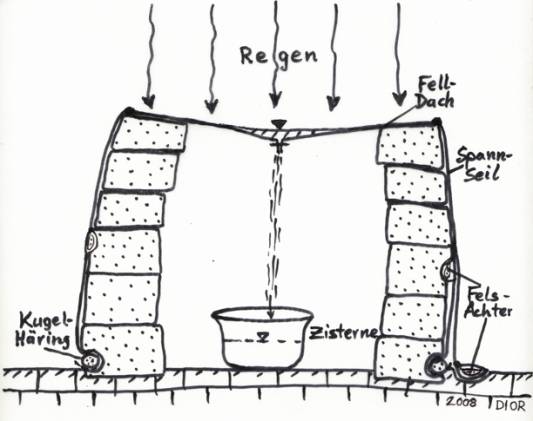
Fig. 1:
Model of a megalithic building of neolithic people at the Maltese Islands with
a cistern on the skin roof to catch rain water (primery cistern, for
airconditioning in summertime, too), ropes for the attachments outside, f. i.
stone balls (“Kugel-Häring”) at the base and rope holes (= rock eighters) and a
big clay stone container for drinking water (secondary cistern).
These skin
roofs served yet a more important purpose. For special reasons the megalithic
buildings always had been errected world-wide at high places. Due to
hydrogeological reasons there, as well known, no springs on high grounds to
provide drinking water. Drinking water had to be carried out arduously from far
away springs. On the other hand, the transport of foodstuffs from surrounding
farmlands was quite easy. Therefore, the megalithic people had the obvious idea
to use the skin roof as a cistern filled by rain water. The centrally located
drainhole filled, at times, a big clay stone container beneath (upto 500 liters
drinking water; BONANNO 2005, p. 38, SULTANA 2006, p. 39). The rest of water in
the (primery) cistern of the skin roof served as a weight to secure the roof
construction during storms as well as a pleasant airconditioning against the
sun, due to the coolness of evaporation.
Those
ancient people were very clever and tricky inhabitants of the Maltese Islands
which were a southern half island of Sicilia in neolithic time, due to the the
well known curve of rising sea level. The neolithic people have been always
underestimated by recent persons.
4. References
BONANNO, A.
(2005): Malta – ein archäologisches Paradies. – 72 p., many figs., (M. J.
Publications Ltd.) La Valletta (translation into German by Rosa KAUFMANN).
MIFSUD, A.,
MIFSUD, S., SULTANA, C. A. & VENTURA, C. S. (2001): Malta – Echoes of
Plato´s Island. – 86 p., many figs., 11 pl., (The Prehistoric Society of Malta)
St. Julians/Malta.
ORTLAM, D. (2003): Die Wiege des Turenne-Denkmals im Lichte neuester Glazialforschungen im Nordschwarzwald – Eine geowissenschaftlich-historische Synthese. – Die Ortenau, 83:393-418, 22 figs., 1 tab., (Histor. Ver. Mittelbaden) Offenburg/Baden.
ORTLAM, D. (2008b): Neue Aspekte zu den Karren-Spuren und zur Dach-Konstruktion der neolithischen Megalith-Bauten auf den Maltesischen Inseln (Mittelmeer). – 13 S., 15 Abb., published into Internet under www.dr-ortlam.de (with recent additives).
SULTANA, S. (2006): The National Museum of
Archeology La Valletta – The Neolithic Period. – 40 p., many figs., (Heritage
books) Malta.
Authors
adress and copyright:
Dr. Dieter ORTLAM, (former) Director and Professor of the Geological Survey of
Bremen, P.O.B. 102701; D-28027 Bremen.